Question
Mathematics
How do you calculate mortgage repayments when interest is compounded semi-annually?
Answer
Mathematics
Expert Answer
Convert the quoted rate into a rate per payment period before using the repayment formula. Monthly payments and semi-annual compounding, which happens twice a year, do not have the same period length.
If is a nominal annual rate compounded twice a year, the six-month growth factor is . The equivalent monthly rate satisfies
so
Use decimal rates. for 6%, enter , not 6.
Convert the rate in an example
Consider a loan of 180,000 currency units, with a nominal annual rate of 6% compounded semi-annually. It is repaid over 20 years through equal payments at each month's end.
The model assumes the rate stays fixed, with no fees or additional payments. It uses the monthly rate equivalent to the stated compounding basis.
That is about per month. Dividing 6% by 12 would instead give 0.5%, which does not reproduce the stated six-month growth factor.
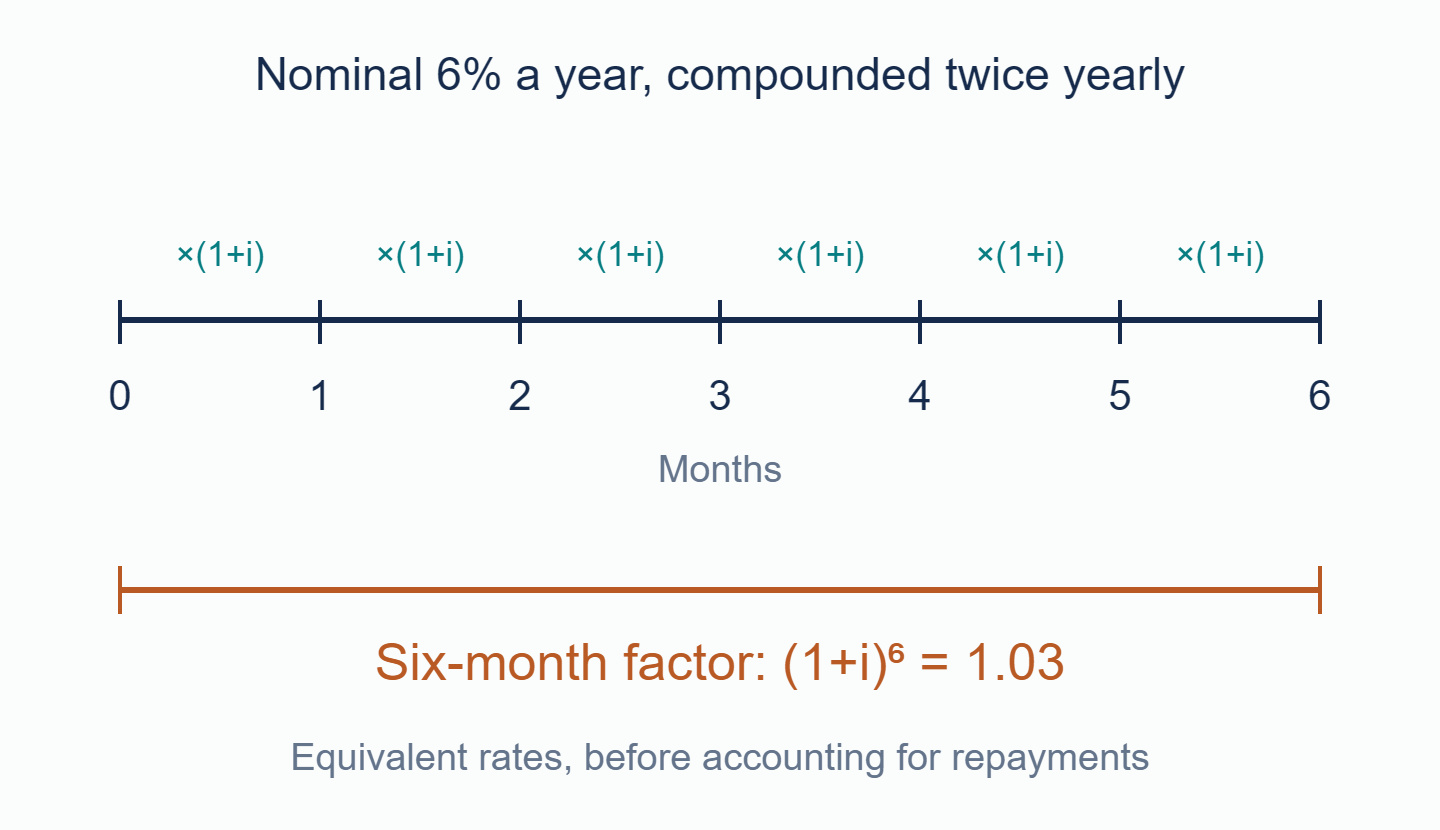
Match interest periods first; then include the month-end payments in the loan calculation.
Calculate the monthly payment
There are payments. If the principal, the amount borrowed, is and each month-end payment is , their values at the loan date must add to . Find those values by discounting, or reversing the interest growth until each payment.
Summing this geometric series gives
Rearrange to obtain
For our example,
Keep the unrounded monthly rate during the calculation.
On a GDC, the TVM solver gives the same payment: enter , , , , and , then solve for .
Check the payment against the balance
In the first month, interest is approximately
The remainder of the payment reduces the principal.
Using unrounded values, the first closing balance is about 179607.01. Later balances follow
After 240 payments, the balance should be zero apart from numerical rounding. A real payment schedule rounded to cents may need a small adjustment to the final payment.
Match the rate description and payment timing
If the question instead gives an effective annual rate , use . Do not divide that rate by two as though it were nominal.
The repayment formula above assumes month-end payments. If payments begin immediately at the loan date, their timing changes and the ordinary-annuity formula, which assumes payments at the end of each period, needs adjustment. At zero interest, the payment is simply .
Try Olivia's mortgage question in the AI HL Number and Algebra Questionbank. Before finding the repayment, match the interest rate to the monthly payment schedule and explain why dividing the quoted annual rate by the number of months is not enough.
Answered by Revision Village IB Expert
Explore More IB Mathematics Resources
Over 80% of IB students globally are experiencing the power of Revision Village