Question
Mathematics
How do you infer the standard deviation of a normal distribution from its interquartile range?
Answer
Mathematics
Expert Answer
For a normal distribution, the quartiles lie standard deviations either side of the mean. Its interquartile range is therefore , so divide the IQR by to find the standard deviation.
Connect quartiles to normal probabilities
The first quartile has 25% of the distribution below it; the third quartile has 75% below it. For a standard normal variable , an inverse-normal calculation gives
These are z-scores: they show how far above or below the mean a value lies, measured in standard deviations. They are not probabilities. If has mean and standard deviation , then . Consequently,
Subtracting eliminates the mean:
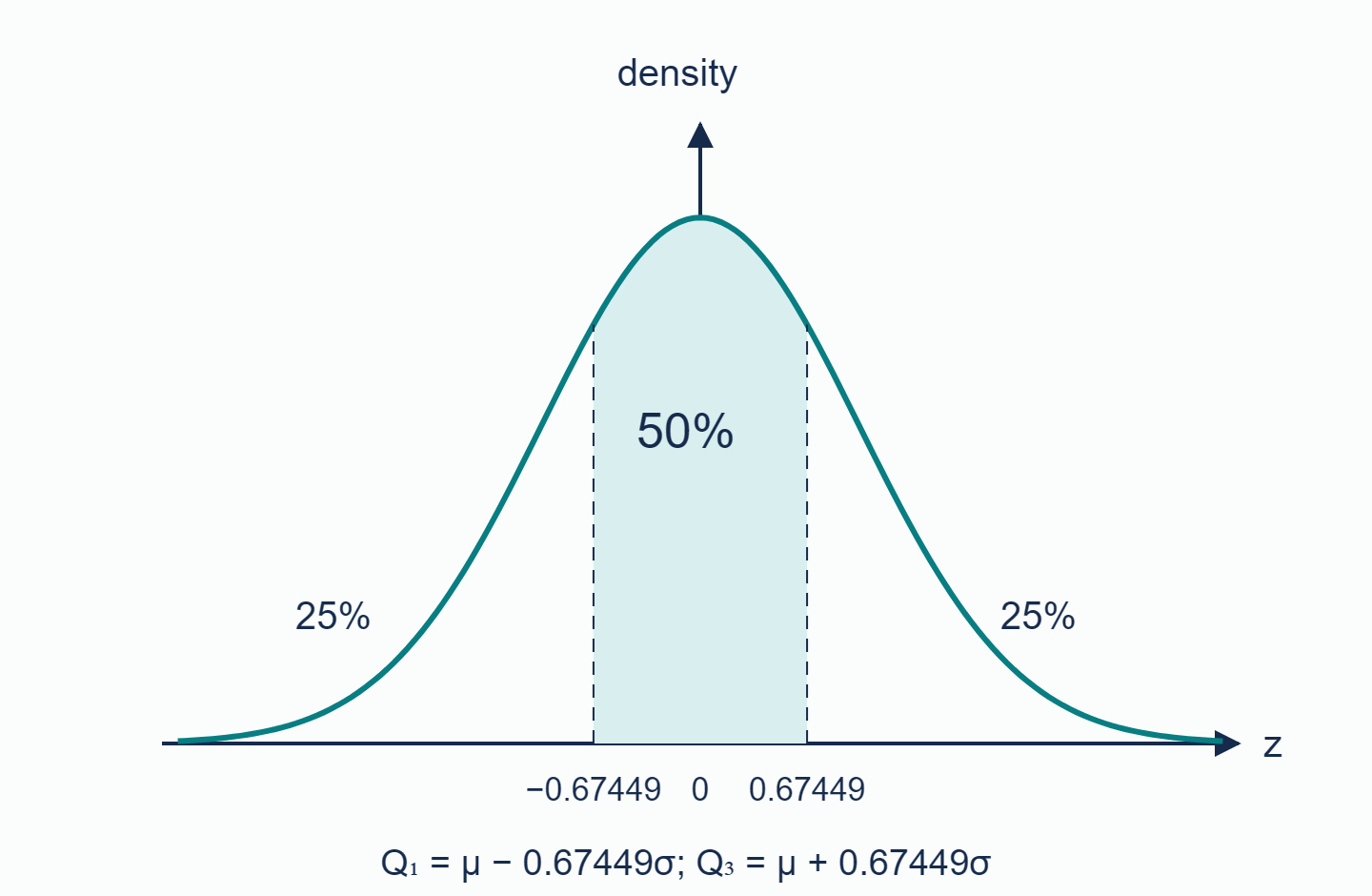
The quartile z-scores stay fixed, so the gap between the quartiles tells you the standard deviation.
Work through an example
Suppose a normally distributed measurement has and . Its IQR is 16, giving
so (3 s.f.).
Normal symmetry also gives . Check by standardising the quartiles, subtracting the mean and dividing by the unrounded standard deviation: and , as required. Standard deviation has the same measurement units as the quartiles.
Use the calculator inputs correctly
On a G.D.C., request inverse normal with left-tail probability 0.75, mean 0 and standard deviation 1. Keep the unrounded result for the calculation. If your calculator asks for a tail choice, confirm that the entered probability is the area to the left of the upper quartile.
The IQR alone determines under this model, but not : shifting a distribution left or right leaves its IQR unchanged. Nor is the IQR equal to ; the interval contains about 68%, not 50%, of a normal distribution.
This relationship is exact for population quartiles of a normal distribution. Applying it to sample quartiles produces an estimate and depends on the normal model being reasonable; it is not a formula for every distribution.
Work through the bottle-mass problem in AA HL Mock Exam, Set 1, Paper 2 to connect the IQR with a practical probability question. Find the standard deviation first, then use it to investigate the chance of under-filled bottles and rejected cartons.
Answered by Revision Village IB Expert
Explore More IB Mathematics Resources
Over 80% of IB students globally are experiencing the power of Revision Village