Question
Mathematics
How do you find the area of a product design with a parabolic top?
Answer
Mathematics
Expert Answer
Model the curved top with a quadratic, using measured points on the edge to find its constants. The area is then the integral of the top edge minus the base, taken across the full width of the design.
Choose coordinates that simplify the model
Suppose a flat product outline is 6 cm wide, with vertical sides. Put the base on the -axis and the left side on the -axis. The top edge then passes through and , with its highest point at .
Because the vertex is known, start from vertex form:
Substitute :
So the top edge is
The coefficient is negative, which matches a top that curves down from its highest point. Substituting gives , so the model fits the right-hand corner too.
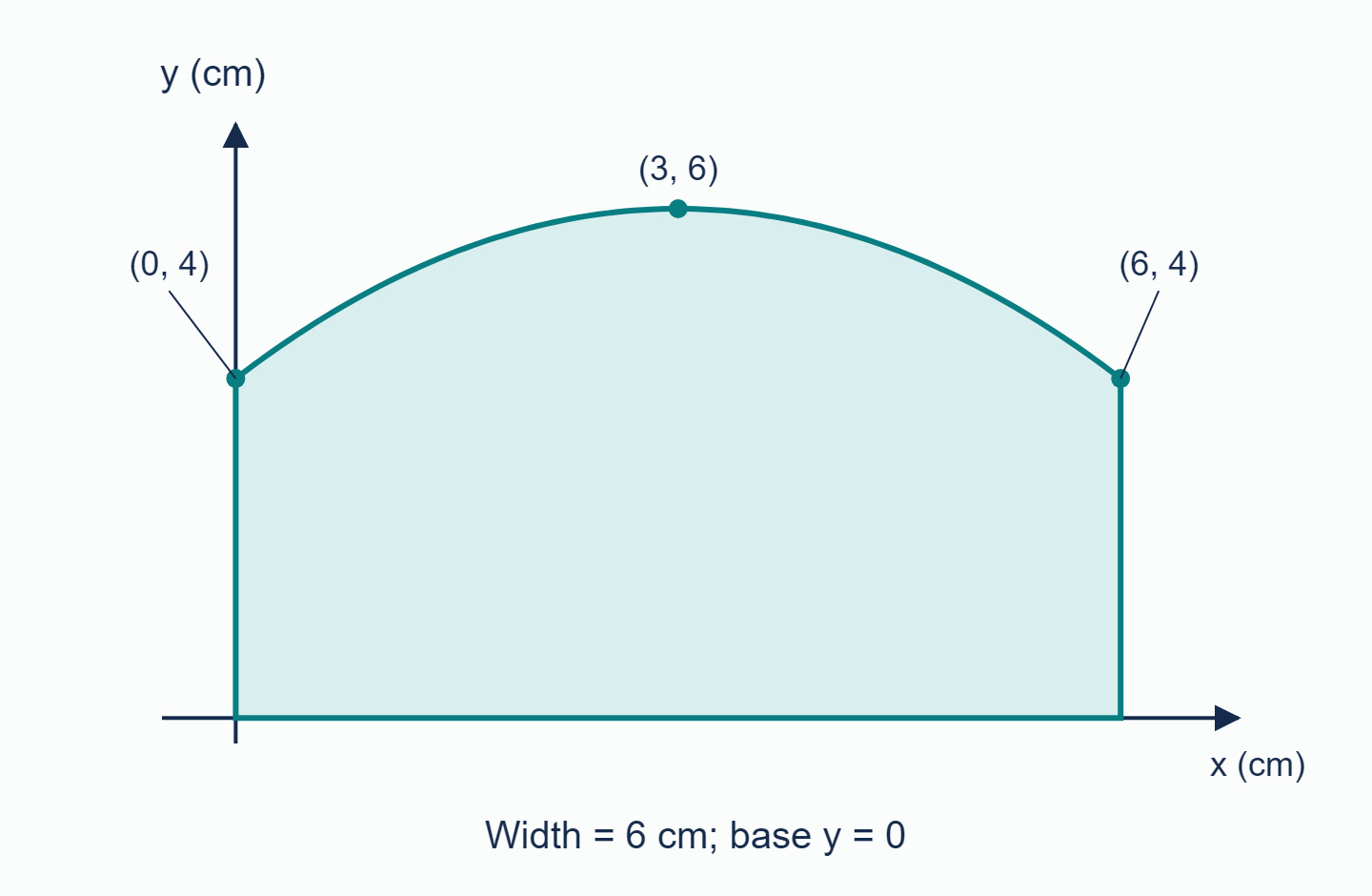
The integral covers the whole profile above its base, not just the curved cap.
Integrate the full profile
The base is , so the strip height is just the top edge:
The definite integral can be directly into the GDC.
Two quick checks:
- Bounds: The design must sit between the rectangle under the shoulders and the rectangle under the peak, and .
- Split: The answer splits into that 24 cm² rectangle plus an 8 cm² curved cap. Forgetting the rectangle and integrating only the cap is the most common slip.
If only three points are given
A question may give three points on the edge without saying which one is the vertex. In that case, substitute them into . Using , and :
This gives , which expands to the same model as before. The GDC's simultaneous-equation solver handles this step quickly. Only treat the middle point as the vertex when the question says it is, or when symmetry makes it certain.
When the base is not the x-axis
For a horizontal base , integrate . If this same top edge sat above a base at , the area would lose a strip, giving .
The integral gives a flat area. To get the volume of material for a sheet of constant thickness, multiply the area by the thickness, with all lengths in the same unit first.
Work through the deodorant-stick design in the AI HL Number and Algebra Questionbank. Use its measured points to find the quadratic, then check that your integral covers the whole shaded design above the base, not just the curved cap.substitued
Answered by Revision Village IB Expert
Explore More IB Mathematics Resources
Over 80% of IB students globally are experiencing the power of Revision Village