Question
Mathematics
How do perpendicular bisectors locate points equally distant from two objects?
Answer
Mathematics
Expert Answer
For two distinct points and , every point on the perpendicular bisector of is equally far from and . It is a whole line of possible locations, not just the midpoint.
To find this line, join the midpoint of with a line perpendicular to . If a third site is added, intersecting two bisectors narrows the choice to a single point equally distant from all three.
Construct a bisector
Take and . Their midpoint is
The gradient of is
The perpendicular gradient is . A line with that gradient through is
or
Both ingredients matter: a perpendicular line through another point would not generally be the bisector.
Why are its points equidistant?
Let . Set the squared distances equal so that you do not need to work with square roots.
Expanding and cancelling the quadratic terms gives
which is exactly . This also shows that every point equally distant from these two sites lies on the line.
Add a third site
Let . The segment is vertical, with midpoint , so its perpendicular bisector is the horizontal line
Intersect it with the bisector of .
The required point is therefore
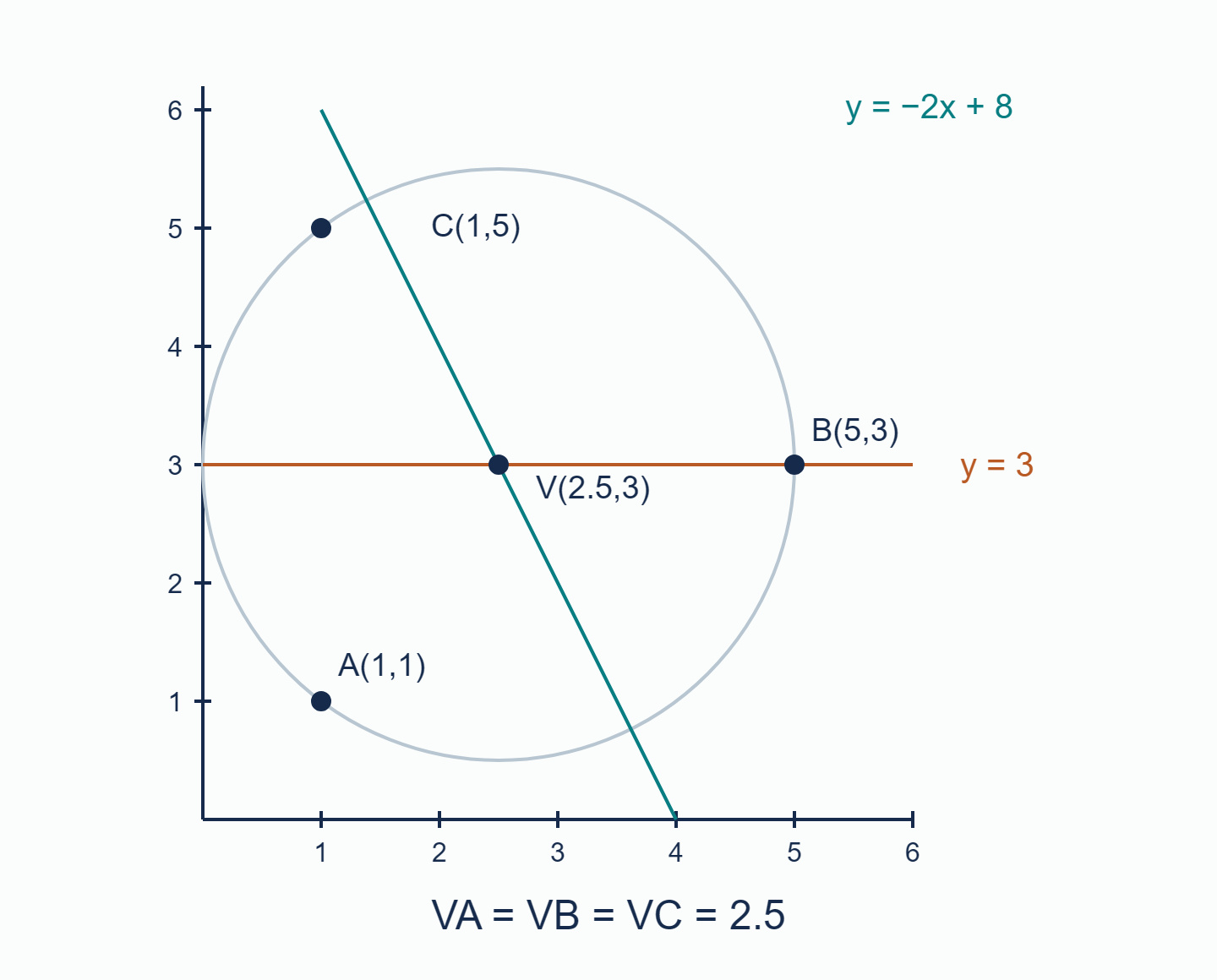
The circle through all three sites confirms the equal distances.
Check all three distances
The squared distances from are
Thus all three distances are 2.5 units. Equivalently, a circle centred at with radius 2.5 passes through , and . For a triangle, this centre is its circumcentre.
Handle special cases directly
A horizontal segment has a vertical perpendicular bisector; a vertical segment has a horizontal one. Do not try to take a negative reciprocal of zero or an undefined gradient.
Three distinct collinear points, points on the same straight line, do not have one finite point equally distant from all three: the relevant bisectors are parallel. When the sites are not on the same straight line, the intersection exists but need not lie inside the triangle.
In a larger Voronoi diagram, only part of a pair's bisector may form a boundary. A point belongs on that boundary only if no other site is closer than the pair.
Try locating the laser-wall intersections in the jewel-vault question in the AI SL Mock Exam, Set 1, Paper 1. Use the perpendicular bisectors to find a shared point, then check why its distances from the jewels make it a risk hot-spot in the model.
Answered by Revision Village IB Expert
Explore More IB Mathematics Resources
Over 80% of IB students globally are experiencing the power of Revision Village