Question
Mathematics
How can log-log regression recover a power law for wildfire size and duration?
Answer
Mathematics
Expert Answer
If size follows a power law in duration , taking logarithms turns it into a straight-line model. Fit a regression line for against : the gradient gives the exponent , and the intercept determines .
Transform both variables
Using base-10 logarithms,
Write and . The regression line is , where , so .
Consider the following made-up data for the duration of a wildfire in hours and the area it affects in hectares.
| (hours) | (hectares) | ||
|---|---|---|---|
| 1 | 5 | 0 | 0.69897 |
| 4 | 40 | 0.60206 | 1.60206 |
| 9 | 135 | 0.95424 | 2.13033 |
| 16 | 320 | 1.20412 | 2.50515 |
Here the points lie exactly on a line of gradient 1.5 and intercept .
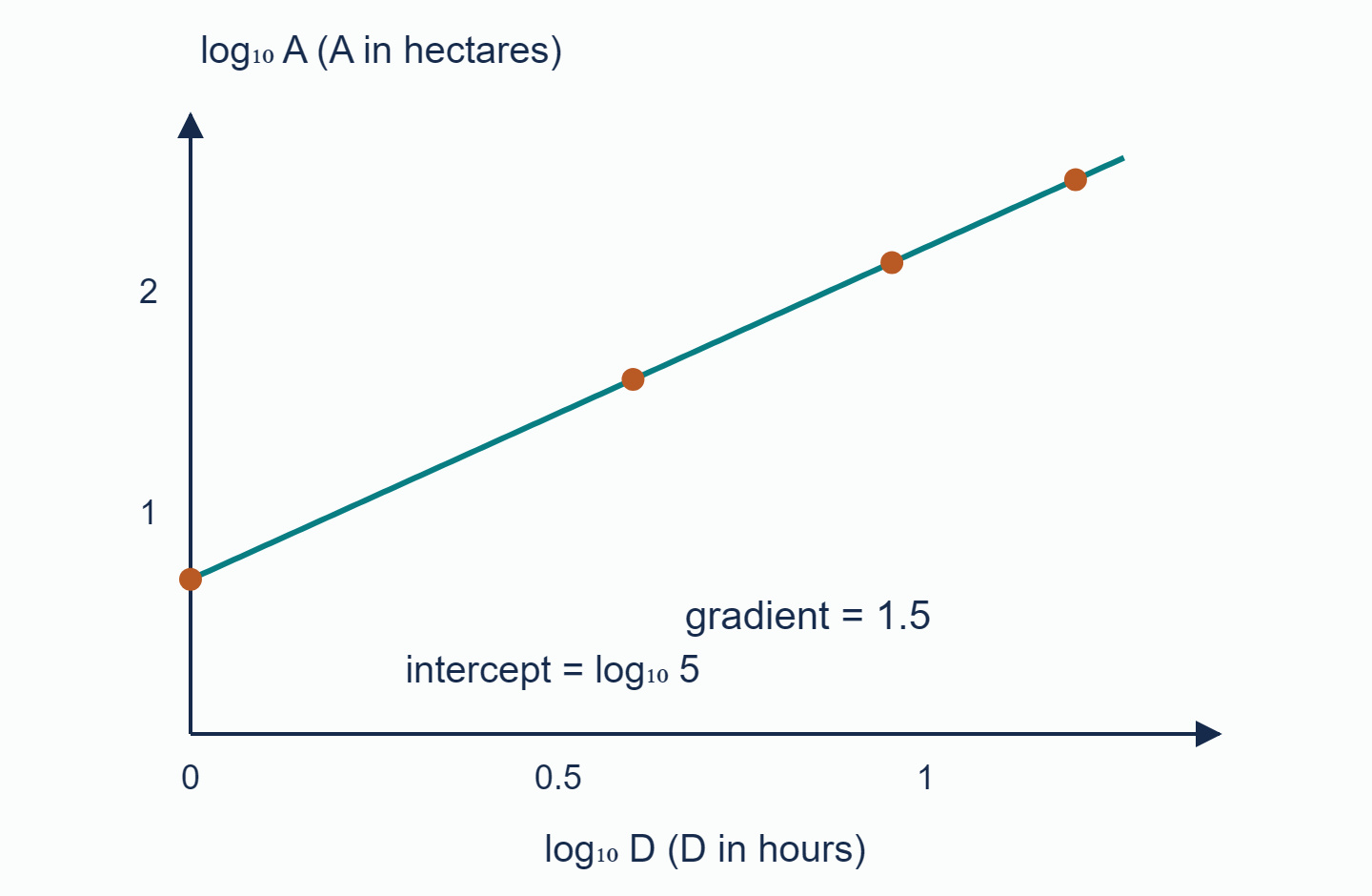
The gradient gives the exponent; raise 10 to the power of the intercept to find the coefficient.
Use your GDC
In an IB exam, find the regression line with your GDC:
- Enter and in two lists.
- Create two further lists for and , letting the GDC calculate the logarithms. Do not type in rounded values such as those in the table above, as rounding can change your answers.
- Run linear regression of on to obtain the gradient and the intercept .
Your GDC may also have a built-in power regression, which fits directly to the original data. Here it gives the same values of and . If a question asks you to use the regression line of on , show that method.
Recover and use the original model
The intercept is , not itself. Undo the logarithm to find the coefficient: , so
At 6 hours, this gives hectares. Doubling the duration multiplies predicted area by ; it does not add a fixed number of hectares.
With natural logarithms the gradient is still , but the coefficient becomes . The numerical value of also depends on the units chosen for duration and area.
Judge the model, not just the line
Real observations will not usually lie perfectly on the transformed line. Check the plot and the residuals, the differences between the observed log values and the line's predictions, to see whether a power relationship is reasonable over the observed range. A straight relationship between and untransformed would suggest an exponential model instead.
Logarithms are only defined for positive values, so data containing zeros cannot be transformed in this way. Wildfire spread also depends on fuel, weather and terrain, so a fitted mathematical relationship should not be treated as a reliable forecast beyond its evidence.
For more practice, build a power-law model from the transformed wildfire data in Question 13 of AI HL Mock Exam, Set 1, Paper 1. Can you explain why the gradient gives the exponent but the intercept must be converted back before it gives the coefficient?
Answered by Revision Village IB Expert
Explore More IB Mathematics Resources
Over 80% of IB students globally are experiencing the power of Revision Village