Question
Mathematics
How do you read the range of a function from its graph?
Answer
Mathematics
Expert Answer
The range is the set of output values the graph reaches. A value belongs to the range if a horizontal line at that height meets at least one included point on the graph.
Look for the lowest and highest heights, decide whether each is included, then check for any missing heights between them. Do not assume every range is one unbroken interval.
Example: a restricted parabola
The graph below shows
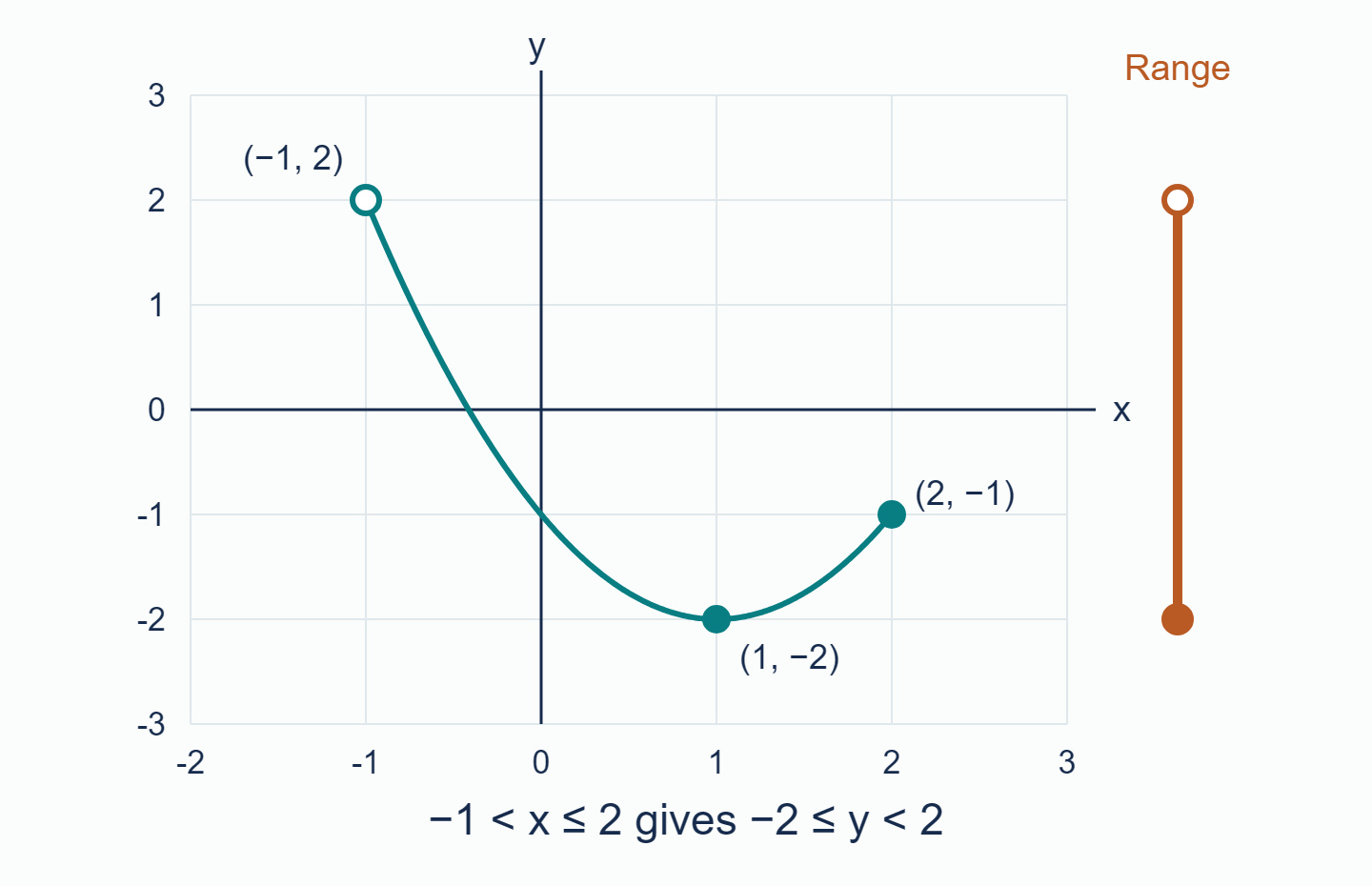
Look at which heights the graph reaches to read its range.
1. Find the lowest height
The vertex is , which lies within the allowed domain. The graph reaches , so this endpoint is included in the range.
Notice that the minimum occurs in the middle of the graph, not at a domain endpoint. Check turning points as well as the ends.
2. Decide whether the upper boundary is reached
As approaches from the right, the graph approaches . But is excluded, shown by the open circle.
Could some other allowed still produce ? Solving
gives or . Neither belongs to , so the height 2 is not reached anywhere on this restricted graph.
3. Check the heights in between
The curve has no break between its minimum and its upper boundary. It reaches every height from up to, but not including, 2. Therefore,
A square bracket includes an endpoint; a round bracket excludes it. The domain is different: it describes the horizontal positions allowed, not the output heights reached.
Does an open circle always exclude that height?
No. An open circle removes that particular point, but another point can have the same -coordinate. For example, removing from would not remove 0 from the range if were still included.
This is why the horizontal-line test is useful: ask whether any included point remains at that height, rather than looking at only one endpoint.
What if the graph has a gap?
Consider a different graph made of two segments: one from to , both ends included, and another from excluded to included.
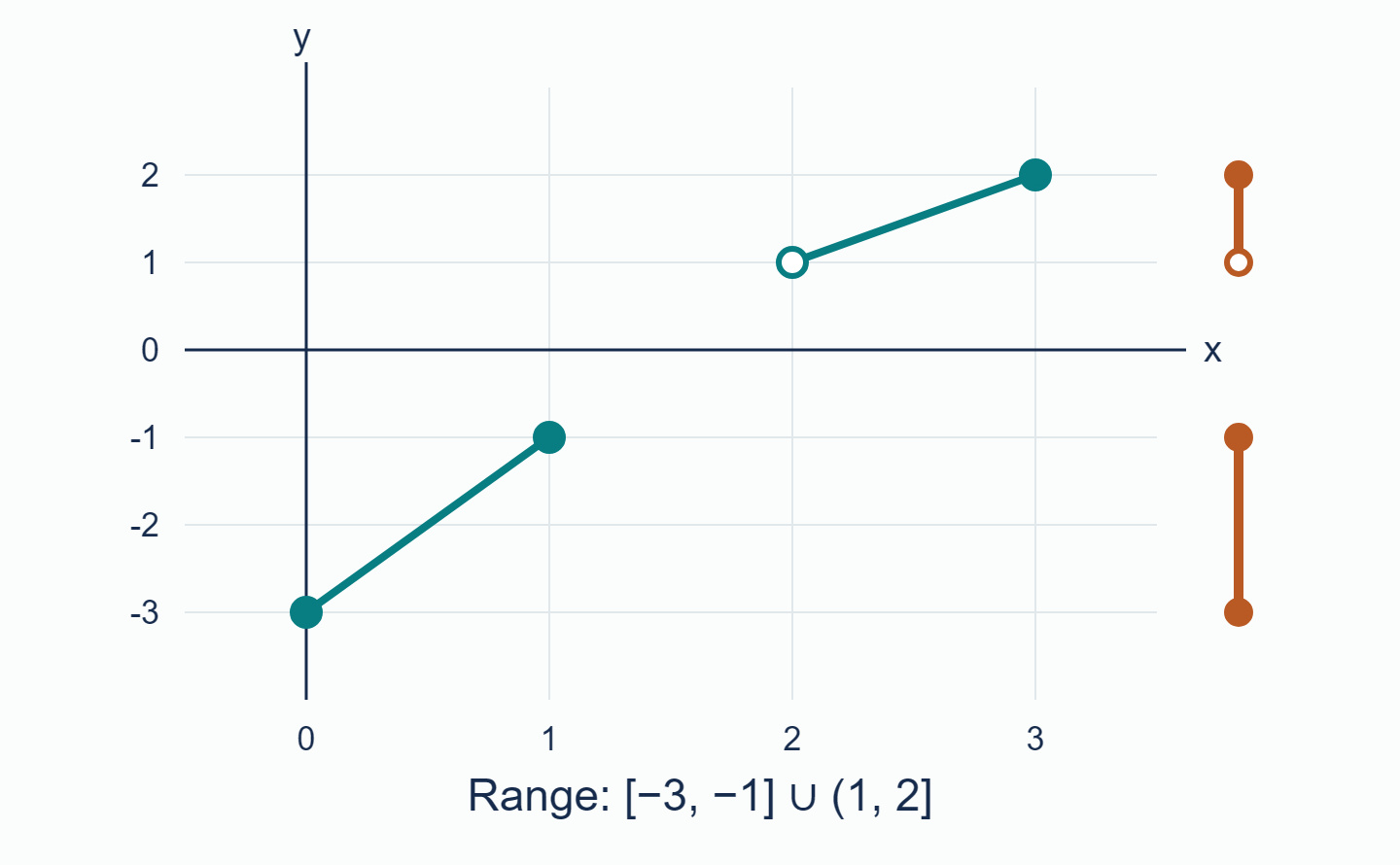
A break in the output heights requires separate intervals.
Its range is
Writing would wrongly include all the missing heights between the segments. The symbol combines the two sets of allowed outputs.
For graphs that continue indefinitely, follow the arrows: a range with no upper or lower limit may use infinity, always with a round bracket. Infinity is not an endpoint the function can reach.
Practise reading a graph
Refresh the difference between inputs and outputs with the Domain & Range Key Concept, then try the graph-reading question in the AA HL Mock Exam, Set 1, Paper 1. Focus on the heights the graph actually reaches, and decide whether its lowest and highest values should be included.
Answered by Revision Village IB Expert
Interested in diving deeper into this concept?
Explore More IB Mathematics Resources
Over 80% of IB students globally are experiencing the power of Revision Village