Question
Mathematics
How do you infer a rational function from its graph and asymptotes?
Answer
Mathematics
Expert Answer
Start with the function form given in the question. A linear-over-linear rational function is a fraction with linear expressions on the top and bottom. For a non-constant function of this type with a vertical asymptote and a horizontal asymptote , write
The asymptotes tell you and . Substitute one known point from the graph to find , then check the resulting curve against the other visible features.
Example: two asymptotes and one point
Suppose the graph has asymptotes and and passes through . We are told it belongs to the linear-over-linear family.
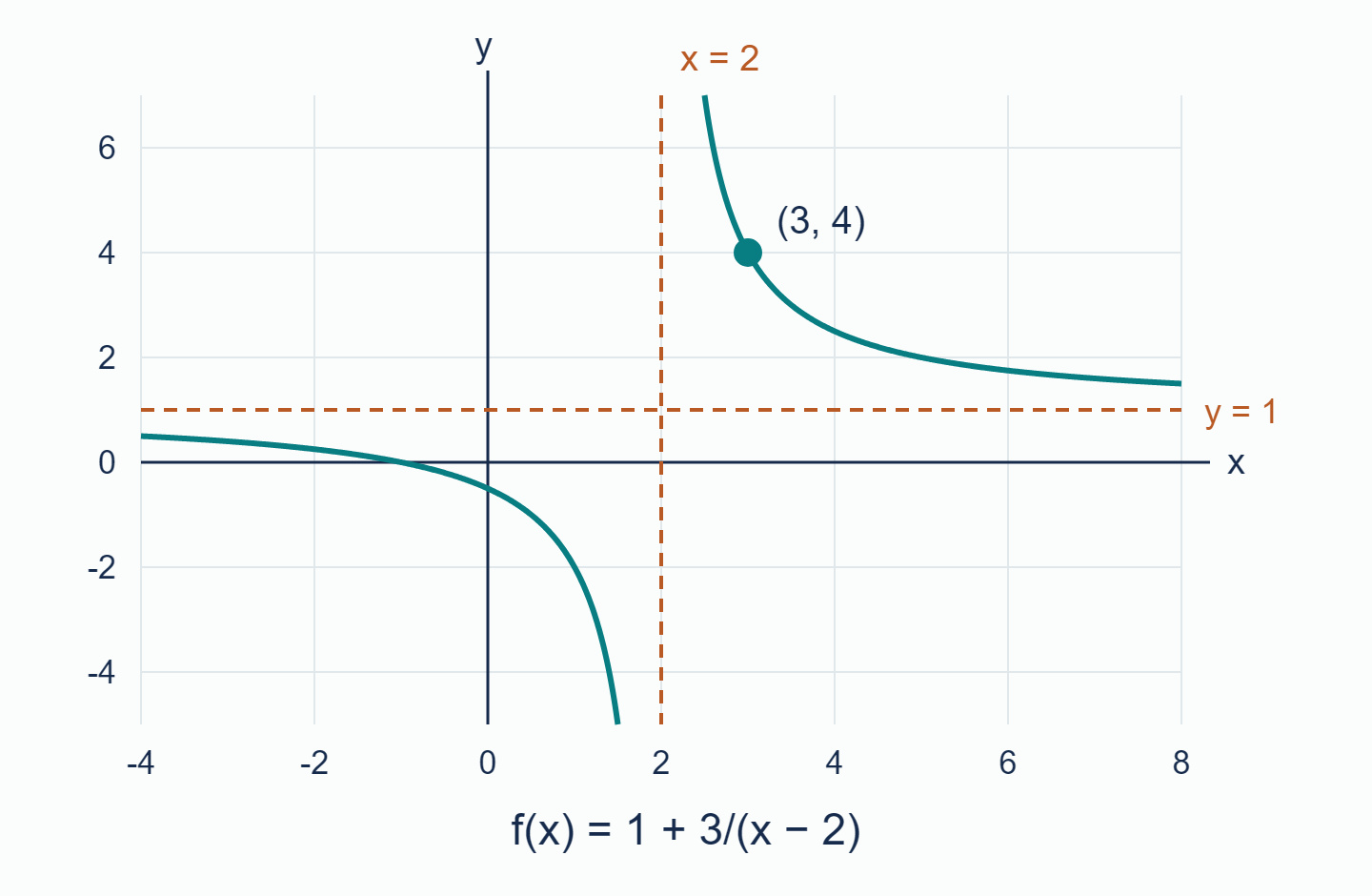
Use the asymptotes to set the form, then the known point to find the remaining constant.
1. Build the asymptotes into the expression
Using and gives
The denominator makes unavailable. As becomes large, the fraction approaches zero, leaving .
2. Use the point to find the remaining constant
Substitute and :
Therefore,
In general, a point gives .
3. Check the shape, not just the point
For , the fraction is positive, so the right-hand branch lies above . It rises without bound as approaches 2 from the right.
For , the fraction is negative, so the left-hand branch lies below . It falls without bound as approaches 2 from the left.
The intercepts provide two more checks:
These should agree with the graph. If they don't, revisit the asymptote coordinates, the point you used or the assumed function form.
What if the question gives ?
Its horizontal asymptote is , and its vertical asymptote is , provided no factor cancels. In this example, and . The point then gives
which produces the same function. Notice the sign: the asymptote requires in the denominator, not .
Are the asymptotes enough on their own?
No. Even within this family, and have the same asymptotes but different graphs. Beyond that family, a term such as can change the shape while leaving those asymptote locations unchanged. Use the algebraic form given in the question, then look for enough graph information to find its unknown constants.
Also check whether a factor cancels before deciding that there is a vertical asymptote. The expression equals 1 wherever it is defined: it has a hole at , not a vertical asymptote.
Check your graph-reading skills
Try reconstructing the rational function shown in the AA SL Mock Exam, Set 1, Paper 1. Use the asymptotes and the marked point to find the unknown constants, then check whether your expression matches the shape of the graph.
Answered by Revision Village IB Expert
Explore More IB Mathematics Resources
Over 80% of IB students globally are experiencing the power of Revision Village