Question
Mathematics
How do you calculate annuity payments from a retirement fund?
Answer
Mathematics
Expert Answer
First find the fund's value when withdrawals begin. Treat that amount as the present value of the annuity, then calculate the equal payment that uses up the fund over the stated number of periods.
For withdrawals at the end of each period,
Here is the fund at the start of the payout stage, is the interest rate per payment period, is the number of payments and is each withdrawal. This formula assumes a constant rate, no extra deposits or fees, and a final balance of zero.
Keep the two stages separate
Consider an IB-style model. A deposit of earns 4% per year, compounded annually, for five years. At retirement, the whole balance moves into a fund paying 3.6% nominal annual interest, compounded monthly. Equal withdrawals are made at each month-end for 15 years.
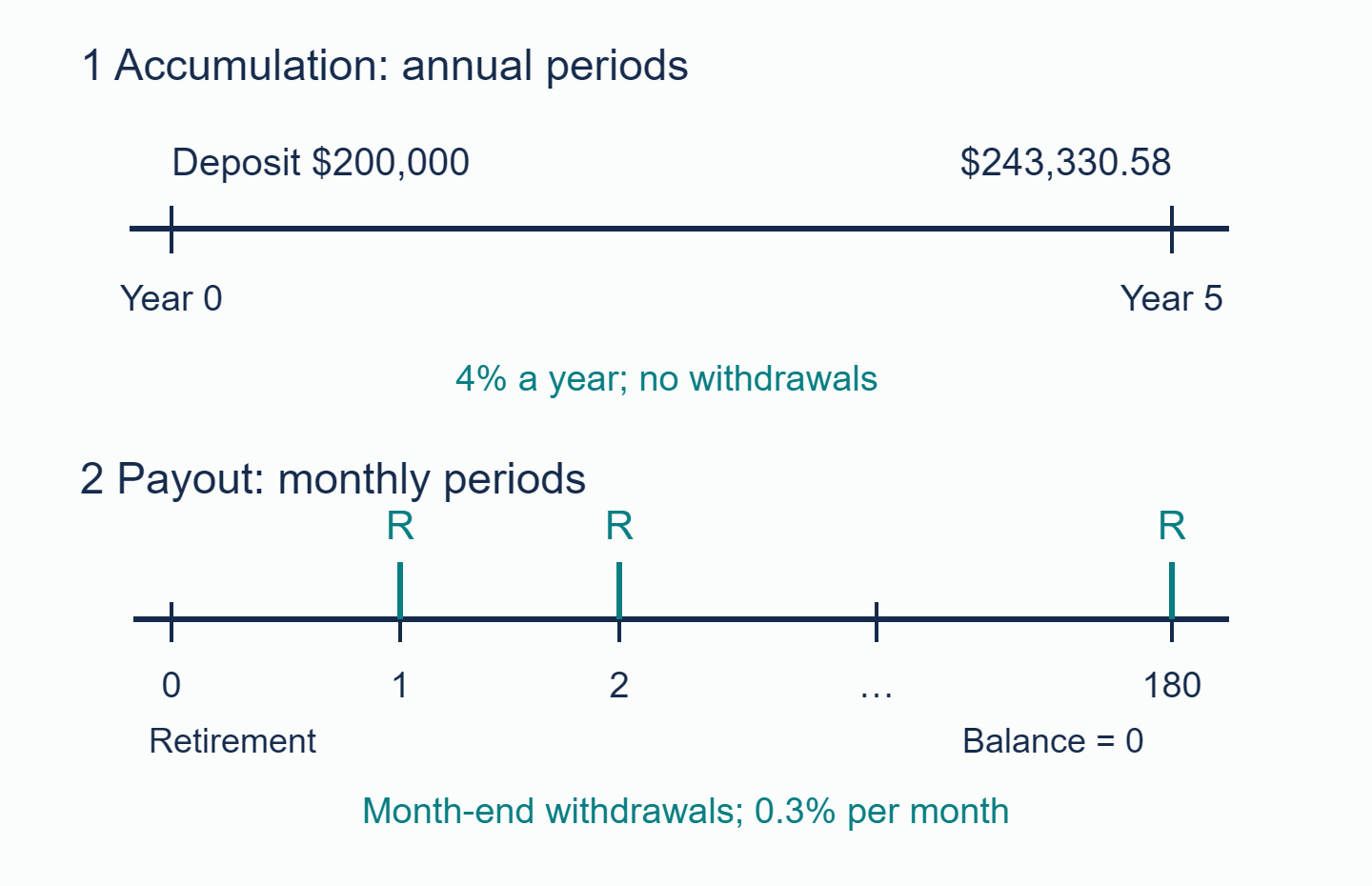
Start counting time again when the withdrawals begin.
1. Grow the original deposit
There are no withdrawals during the first stage, so compound interest gives
This is the future value of the original deposit, but the present value at the start of retirement. It is the same balance: the name changes because we are now measuring from the retirement date.
Keep the unrounded balance for the next calculation.
2. Match the rate to the payments
The nominal rate is compounded monthly and withdrawals are monthly, so
Do not put or into a formula that expects the monthly decimal rate. If the given 3.6% were an effective annual rate instead, the monthly rate would be .
3. Calculate the withdrawal
This gives an equal monthly withdrawal of approximately
The unrounded mathematical payment uses up the fund exactly; rounding every payment to cents can leave a small final adjustment.
Why does the formula work?
Work out what each future withdrawal is worth at the retirement date. This is called discounting: you divide by the interest growth factor for the time until the payment. The first withdrawal is one month away, the second two months away, and so on:
These discounted amounts form a geometric series. Summing it gives
which rearranges to the payment formula. Interest continues to be earned on the remaining balance during retirement, so simply dividing by 180 would underestimate the payment in this positive-interest example.
Check your finance-solver setup
For a solver with annual percentage interest and separate payment/compounding settings, use , , , , and END payments. Solve for . The signs show the direction of the money: the initial investment is money paid out, so it is negative; withdrawals received are positive. Reversing both signs gives the same payment amount.
If the interest rate is , the formula gives so use instead..
Test your understanding in the Questionbank
Follow Emily's savings into retirement in the AI HL Number & Algebra Questionbank. Try separating the saving and withdrawal stages, then explain why the balance at the end of the first stage becomes the starting value for the second.
Answered by Revision Village IB Expert
Explore More IB Mathematics Resources
Over 80% of IB students globally are experiencing the power of Revision Village