Question
Mathematics
How do selected sixteenth roots of unity produce an exact trigonometric sum?
Answer
Mathematics
Expert Answer
Write each root as , select the values of permitted by the question, and add their real and imaginary parts. The roots lie at equally spaced points on a unit circle, so symmetry often simplifies the sum before you evaluate any trigonometric values.
Half-angle identities then turn the remaining sines and cosines into exact radicals, expressions involving roots, rather than decimal approximations.
Example: select the roots strictly in the second quadrant
Find the sum of the roots of satisfying
1. Find their arguments
The sixteen roots are
Their angular separation is . Applying the strict bounds gives
so we need . The roots at and lie on the boundaries and are not included.
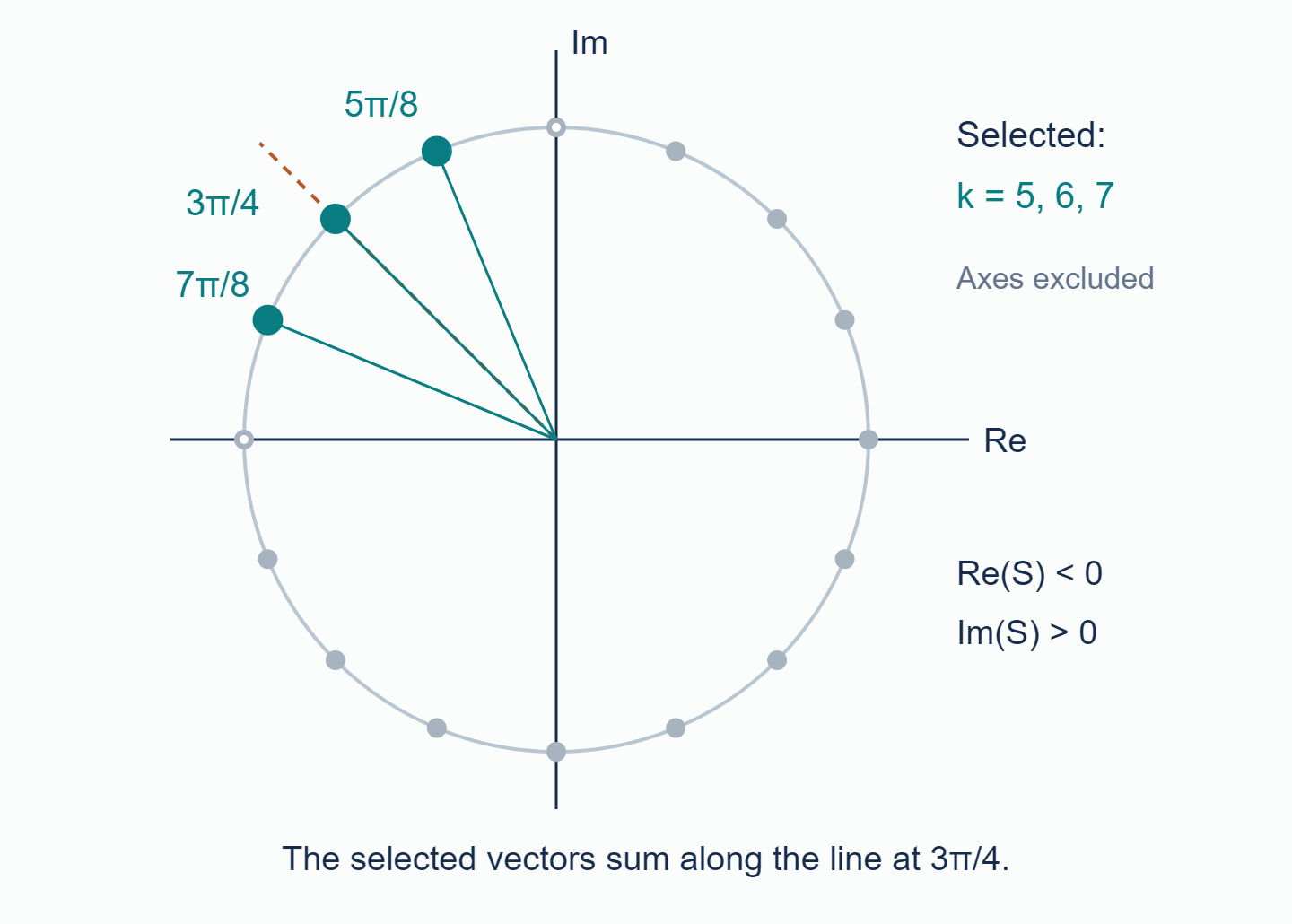
Only the highlighted roots are inside the required angle range; roots on its boundaries are excluded.
2. Use symmetry to organise the sum
Let . The outer two roots are mirror images across the line at angle , and the middle root lies on that line. Their sum therefore points in that direction: its real part is negative and its imaginary part is equally positive.
We can also see this algebraically. Put
Using reference angles, the three roots are
Their sum is therefore
If we call by the name , this is . That sign pattern agrees with the diagram.
3. Evaluate exactly
From , setting gives
Since is in the first quadrant, take the positive root:
Similarly, , so
Thus
and the required exact sum is
Numerically, , so . A sum of unit-length vectors can have components greater than 1; it is the individual roots, not their sum, that must lie on the unit circle.
Checks that prevent common mistakes
Use each root once: repeats . Check which angles are allowed before summing; all sixteen roots sum to zero, but a selected subset usually does not. Finally, choose signs from the relevant quadrants. A calculator decimal may check the result, but it doesn't replace the radical expression when the question asks for an exact value.
Explore another selection
Explore the ideas further in Complex Numbers & De Moivre's Theorem, then try the first-quadrant roots-of-unity question in the AA HL Number & Algebra Questionbank. Sketch the selected roots before adding them, and use their symmetry to predict the signs of the real and imaginary parts.
Answered by Revision Village IB Expert
Interested in diving deeper into this concept?
Explore More IB Mathematics Resources
Over 80% of IB students globally are experiencing the power of Revision Village