Question
Mathematics
How do you fill a three-set Venn diagram from survey totals?
Answer
Mathematics
Expert Answer
Begin with the region shared by all three sets, then fill the three pair-only overlaps, then the single-set regions. Calculate the number outside the circles last.
The important distinction is that a total such as normally includes people who are also in . It means "in both A and B", not "in A and B only".
An example with 120 students
A survey asks which activities students enjoy.
| Activity | Number of students |
|---|---|
| : art | 58 |
| : basketball | 50 |
| : coding | 44 |
| Art and basketball | 24 |
| Art and coding | 20 |
| Basketball and coding | 18 |
| All three | 8 |
Here the pair totals include the students who enjoy all three activities.
1. Put 8 in the centre
This count belongs to every pair intersection as well as to every set total. Placing it first prevents us from counting those same students again in the surrounding regions.
2. Remove the centre from each pair total
These are three separate regions. A student cannot belong to more than one of them.
3. Complete each circle
The art circle must contain 58 students altogether. Its three overlap regions already contain , leaving 22 in art only. Apply the same reasoning to the other circles:
4. Find the outside region
Add the seven separate, non-overlapping regions inside the circles:
Therefore students enjoy none of the three activities.
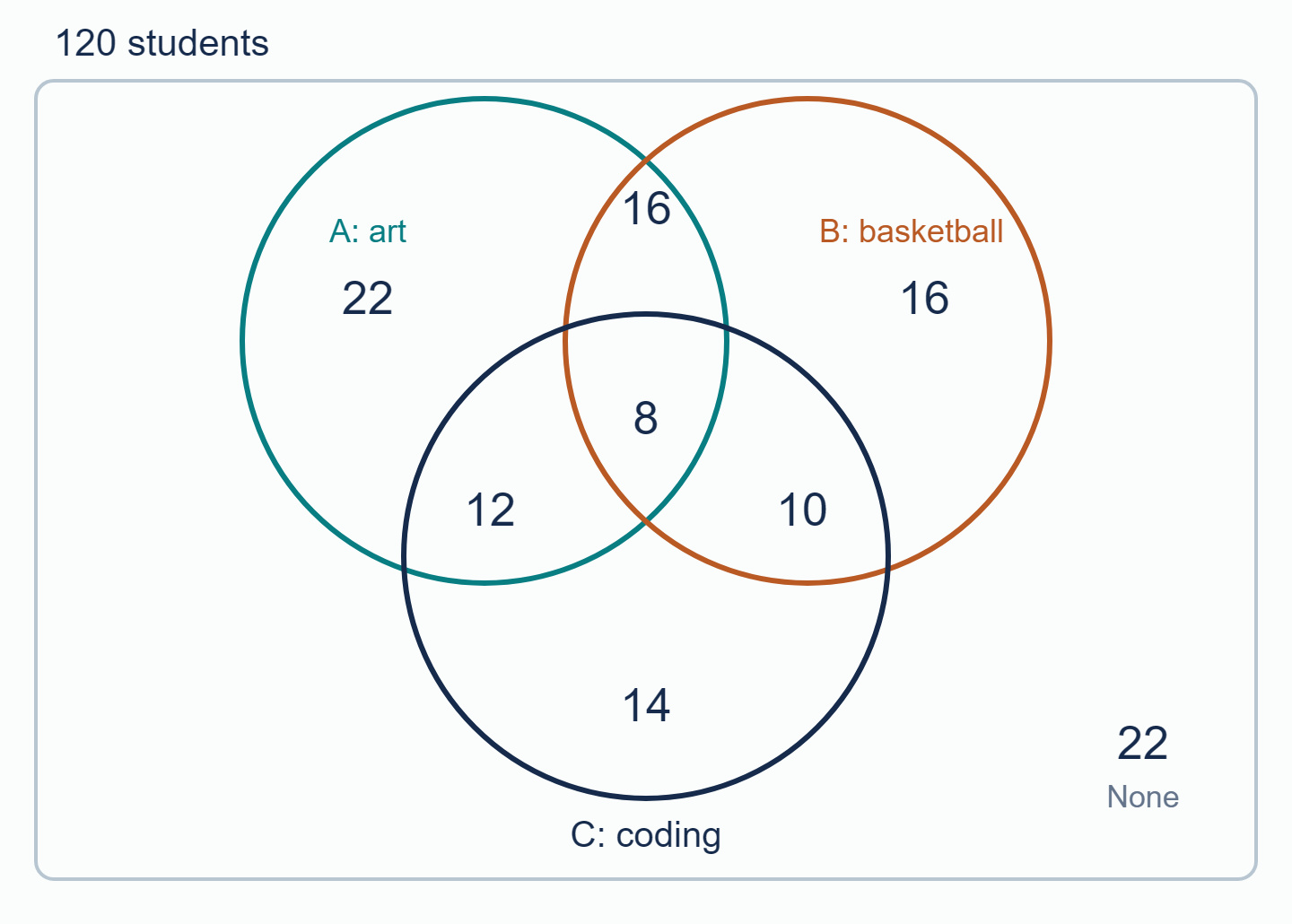
The pair-only regions exclude the eight students in the centre.
Check your diagram
Rebuild each original total from the regions. For example, the basketball circle gives , while the art-and-coding overlap gives .
You can also check the union, the number in at least one set, using inclusion-exclusion:
Adding the outside count must then return the survey total of 120. A negative region is a warning: either a total was interpreted incorrectly or the supplied data are inconsistent.
Reading the finished regions
“Exactly one" means the three single-set regions: . “Exactly two" means the pair-only regions: . The centre is not included in either answer.
If a question explicitly says “24 students enjoy art and basketball only", do not subtract the centre from that number. The wording determines which region the number describes.
Put your diagram skills to work on the after-school clubs survey in the AI SL Mock Exam, Set 1, Paper 2. Start with the students in all the clubs, then see whether your completed regions reproduce every total in the question.
Answered by Revision Village IB Expert
Explore More IB Mathematics Resources
Over 80% of IB students globally are experiencing the power of Revision Village