Question
Mathematics
How do you use three-dimensional geometry to calculate a viewing angle from a tower?
Answer
Mathematics
Expert Answer
Find the horizontal distance from the observer to the foot of the tower first. Then use that ground distance and the height difference as the two shorter sides of a vertical right-angled triangle, with the line of sight as its hypotenuse.
Find the ground distance
Take the -axis as vertical. Suppose the foot of a tower is at , the observation point at its top is , and a person stands at , all in metres. On a plan view, is 24 m along one direction and 18 m along the other, so the ground distance is
Using only the 24 m coordinate is a common slip. It gives and an angle of , which is too steep because the observer is really 30 m away on the ground.
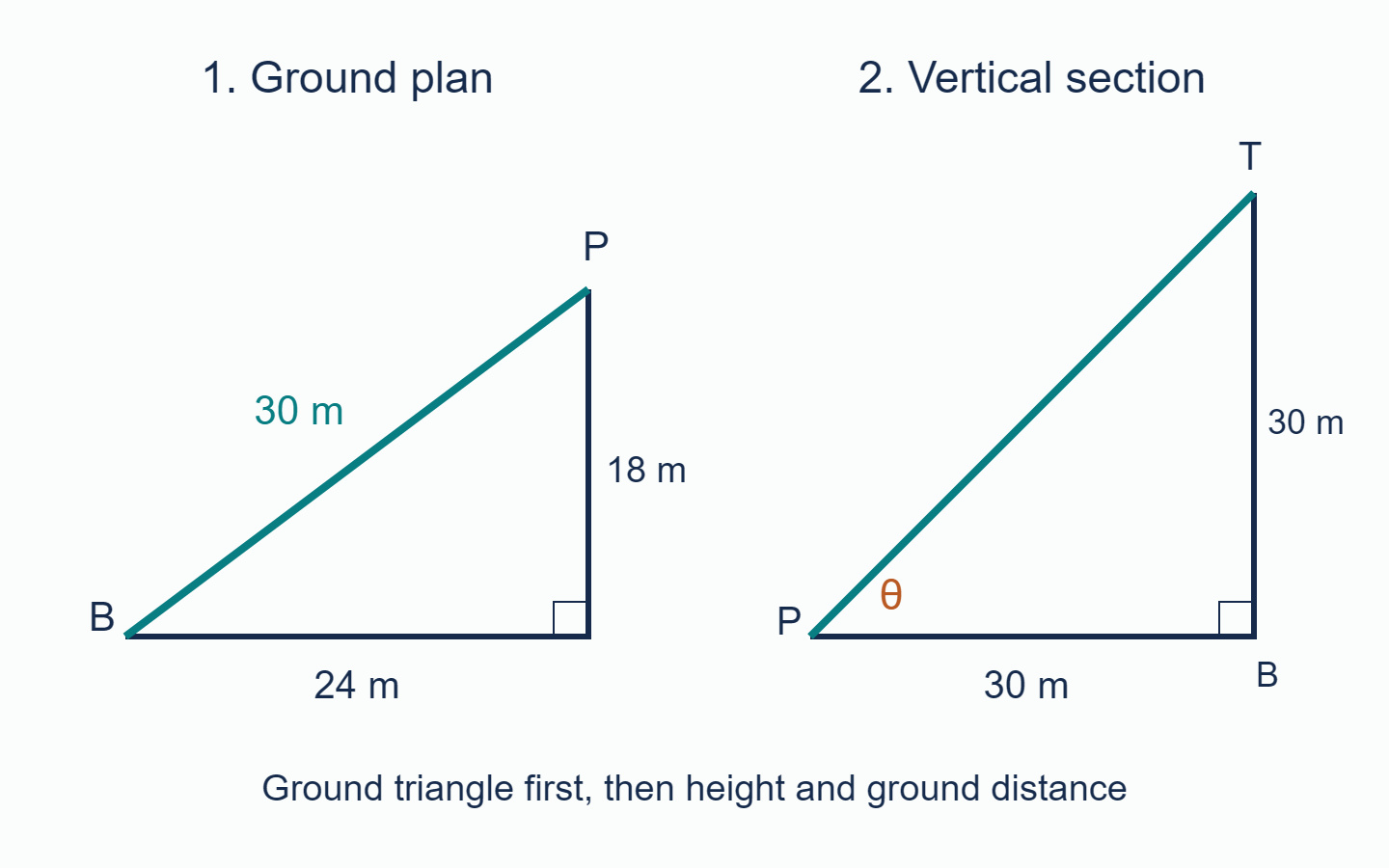
The diagonal of the ground plan becomes the horizontal side of the viewing triangle. Both sketches are schematic.
Calculate the viewing angle
Let be the angle of elevation at , measured up from the horizontal. In the vertical triangle , is opposite and is adjacent:
The line of sight has length
Looking down from , the angle of depression to is also . The horizontal lines through and are parallel, so the two angles are alternate angles. The angle between the line of sight and the tower itself is .
Adjust for eye level or uneven ground
If the observer's eyes are 1.5 m above the ground, the ground distance stays 30 m but the vertical side shrinks to m:
The same idea handles uneven ground. Measure both points from one reference level and subtract. An observer standing on a 4 m bank would use a vertical difference of m.
The angle a tower subtends at the eye
A question may instead ask for the angle between two sightlines, for example from the observer's eye at to the top and to the foot of the tower. That angle is not the angle of elevation. Use the vectors
and the scalar product:
This is the elevation to the top plus a further down to the foot, which confirms the result. Marking the requested angle on a diagram before choosing a method avoids mixing up these two angles.
Revisit the right-triangle ratios with the Right-Angled Trigonometry Key Concept. As you review it, label the opposite and adjacent sides in your own sightline triangle before choosing a ratio for the viewing angle.
Answered by Revision Village IB Expert
Explore More IB Mathematics Resources
Over 80% of IB students globally are experiencing the power of Revision Village