Question
Mathematics
How does a transition matrix model switching between two states?
Answer
Mathematics
Expert Answer
A transition matrix records the probability of moving from each current state to each next state. In the IB convention, the state shares are written as a column vector, so each column of the matrix belongs to one starting state and must add to 1.
Build a two-state model
Suppose 90% of subscribers to service A stay with A each month, while 30% of B subscribers switch to A. With the states ordered A, then B,
The first column lists where A's subscribers go: 0.9 stay with A and 0.1 move to B. So the bottom-left entry is the probability of moving from A to B. A common slip is to read across a row instead. The two outcomes from A are 0.9 and 0.1, not 0.9 and 0.3.
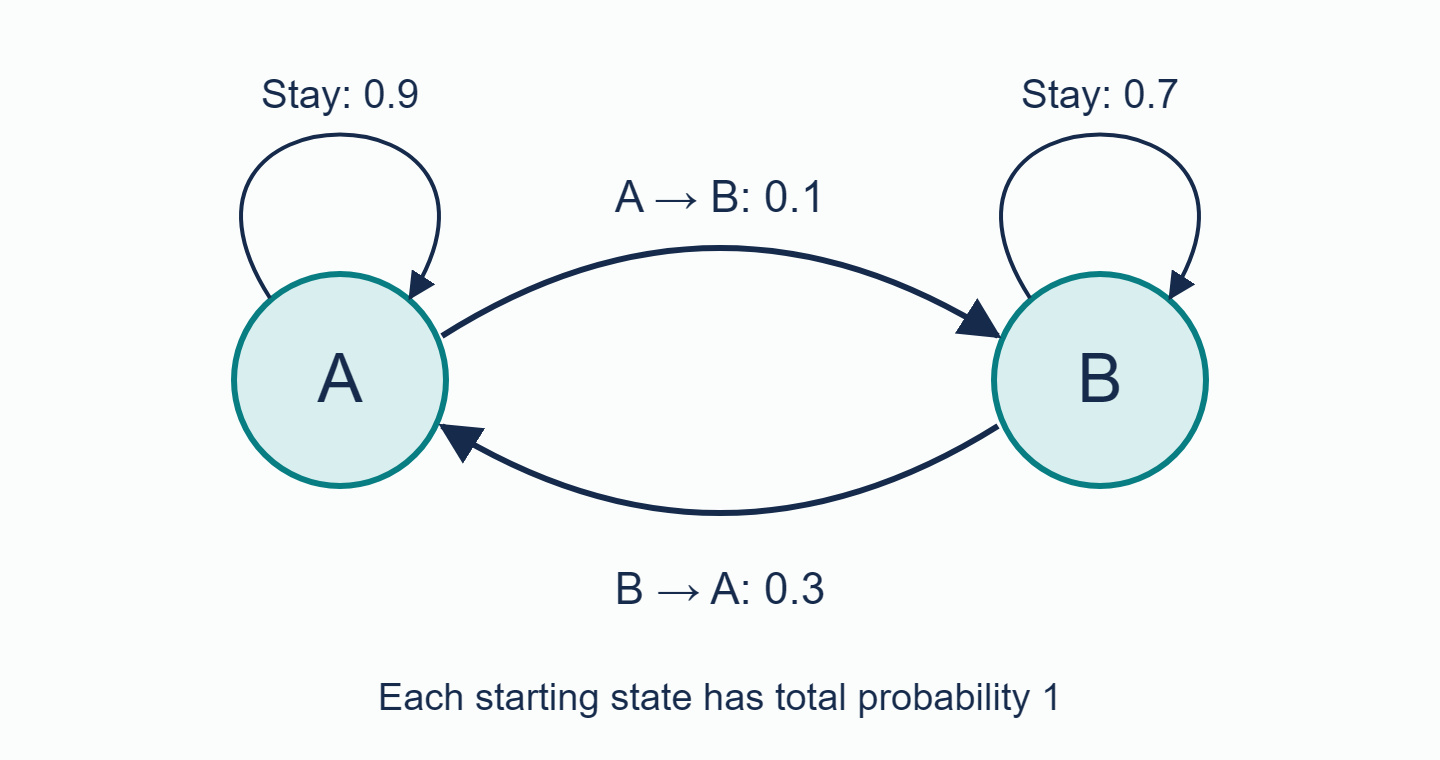
The arrows leaving each state fill one column of the transition matrix.
Some textbooks use a row vector instead, so each row sums to 1 and the matrix is the transpose of this one. Check which convention a question uses before multiplying.
Project the shares forwards
If the current shares are 60% A and 40% B, then
The entries still add to 1, which is a quick check. After months, use , with found on the GDC. The matrix is raised to the power . It is not multiplied by .
Find the stationary distribution
A stationary distribution satisfies , so the shares don't change from one month to the next. Write A's share as and B's share as . The top row gives
Equivalently, is the eigenvector of for eigenvalue 1, scaled so that its entries sum to 1.
Customers keep switching at this distribution, but the flows balance. Each month A loses of the market and gains .
The shares really do approach this distribution. From the top row, , so the gap between and 0.75 is multiplied by 0.6 each month:
This gives 0.66 after one month and 0.696 after two, and after a year the gap is below 0.001. The factor 0.6 is the other eigenvalue of . Not every transition matrix settles down like this. With , everyone switches every month, so the shares alternate forever.
One household versus the whole market
The columns of answer a different question: the probability that a single household is with each provider after months, given where it started. Here,
So a household that starts with A has probability 0.84 of being with A two months later, while one that starts with B has probability 0.48. As grows, both columns approach . In the long run, a household's chance of being with A no longer depends on where it started, and it matches A's predicted market share.
Limits of the model
The predictions assume that the switching probabilities stay fixed and that nobody joins or leaves the market. A price change or a new competitor would change , so long-run shares are model predictions, not guarantees.
Explore switching between NetFast and WebSpeed in AI HL Mock Exam, Set 1, Paper 2. Can you tell apart a household's probability of using a provider after several years and that provider's predicted long-run market share?
Answered by Revision Village IB Expert
Explore More IB Mathematics Resources
Over 80% of IB students globally are experiencing the power of Revision Village