Question
Mathematics
How do you calculate the volume formed by rotating a region between two curves?
Answer
Mathematics
Expert Answer
Slice the solid perpendicular to the rotation axis. Each slice is usually a washer: a disc with a circular hole in the middle. With outer radius and inner radius , its area is , and integrating these areas along the axis gives the volume.
Identify the region and the radii
Rotate the region between and about the -axis. The curves meet where , so at and .
Between these values, . For example, at the line is at and the parabola is at . Both curves lie above the axis, so the outer radius is and the inner radius is .
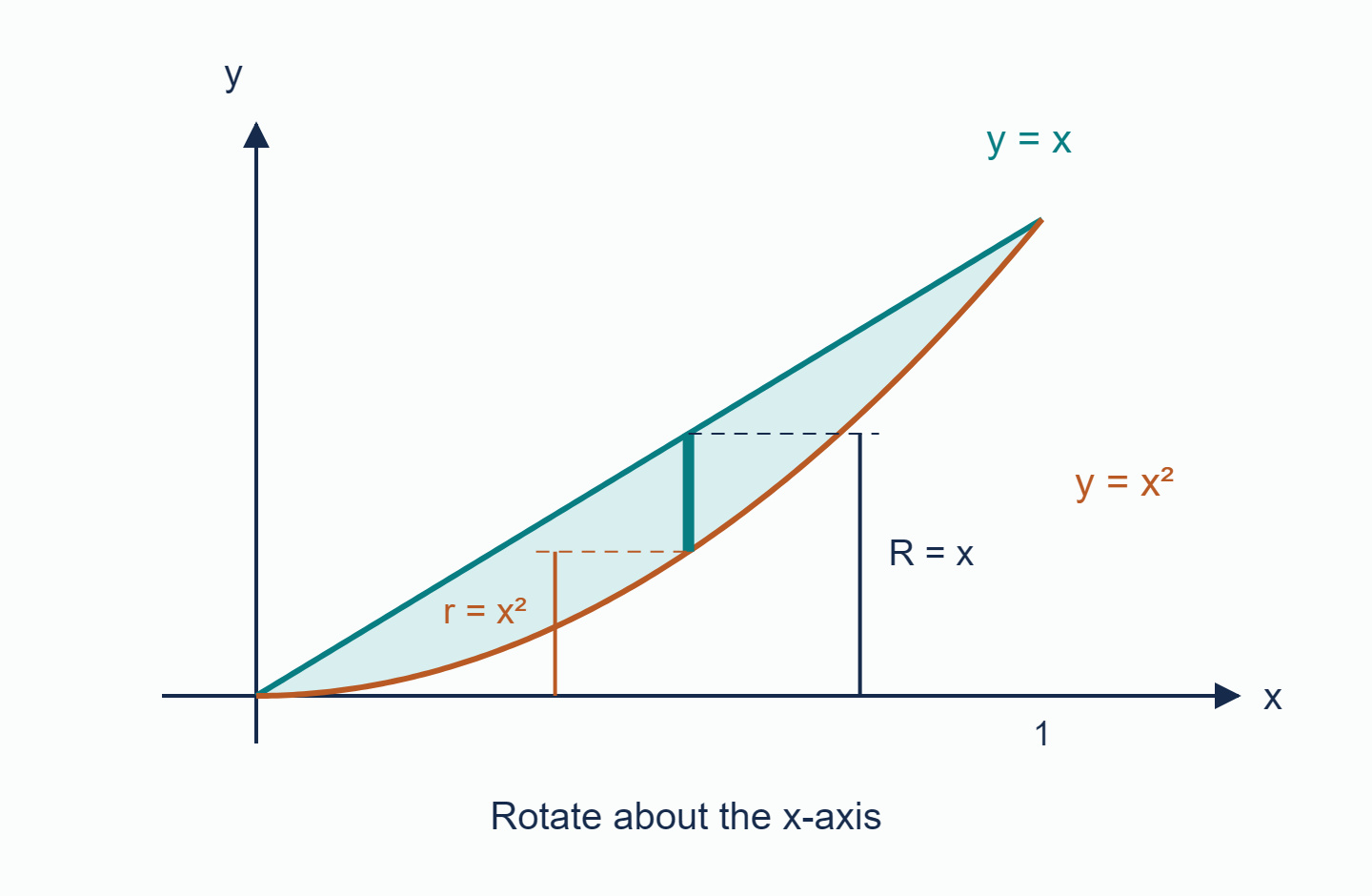
Square each radius separately before subtracting the two disc areas.
Set up and evaluate the integral
A washer of thickness has volume close to . Adding these from to :
That is units³ (3 s.f.). On calculator papers, the GDC evaluates the definite integral directly.
The same answer comes from subtracting two volumes. Rotating alone gives a cone of volume , and rotating alone gives . The washer solid is the cone with that inner solid removed, and .
Why not square the gap?
Each slice is a large disc with a smaller disc removed. Its area is not that of a disc whose radius is the gap between the curves:
At , the correct washer area is . Squaring the gap of gives only , a third of the true value.
Rotate about a different horizontal line
Radii are distances from the axis of rotation, not simply the -values of the curves. Rotate the same region about instead. At each , the distance from to the line is and to the parabola is . The parabola is now further from the axis, so the inner and outer radii swap:
Using and here, out of habit, would give the wrong answer.
If one edge of the region lies on the axis itself, the inner radius is 0 and each slice is a solid disc. A region that crosses the axis needs more care. The parts on either side overlap when rotated, so each slice is filled out to whichever edge is further from the axis.
Rotate about the y-axis
For rotation about the -axis, use horizontal slices and write each radius as a function of . The limits must be -values too. For the same region, becomes and becomes (taking ). At height , the parabola is further from the -axis, so and :
The same region gives three different volumes, , and , depending only on the axis. Sketching one typical slice before integrating shows which radius is which.
Explore the telescope-mirror problem in AI HL Mock Exam, Set 1, Paper 1 to try a rotation about the -axis. Before integrating, sketch a horizontal slice and work out how far each edge lies from the axis, so that you choose the radii correctly.
Answered by Revision Village IB Expert
Explore More IB Mathematics Resources
Over 80% of IB students globally are experiencing the power of Revision Village